
03 / Global WebAR experience.
One QR code, twelve cities, one day
Sole engineer · Global WebAR experience · Dorier for Scopely · 2025
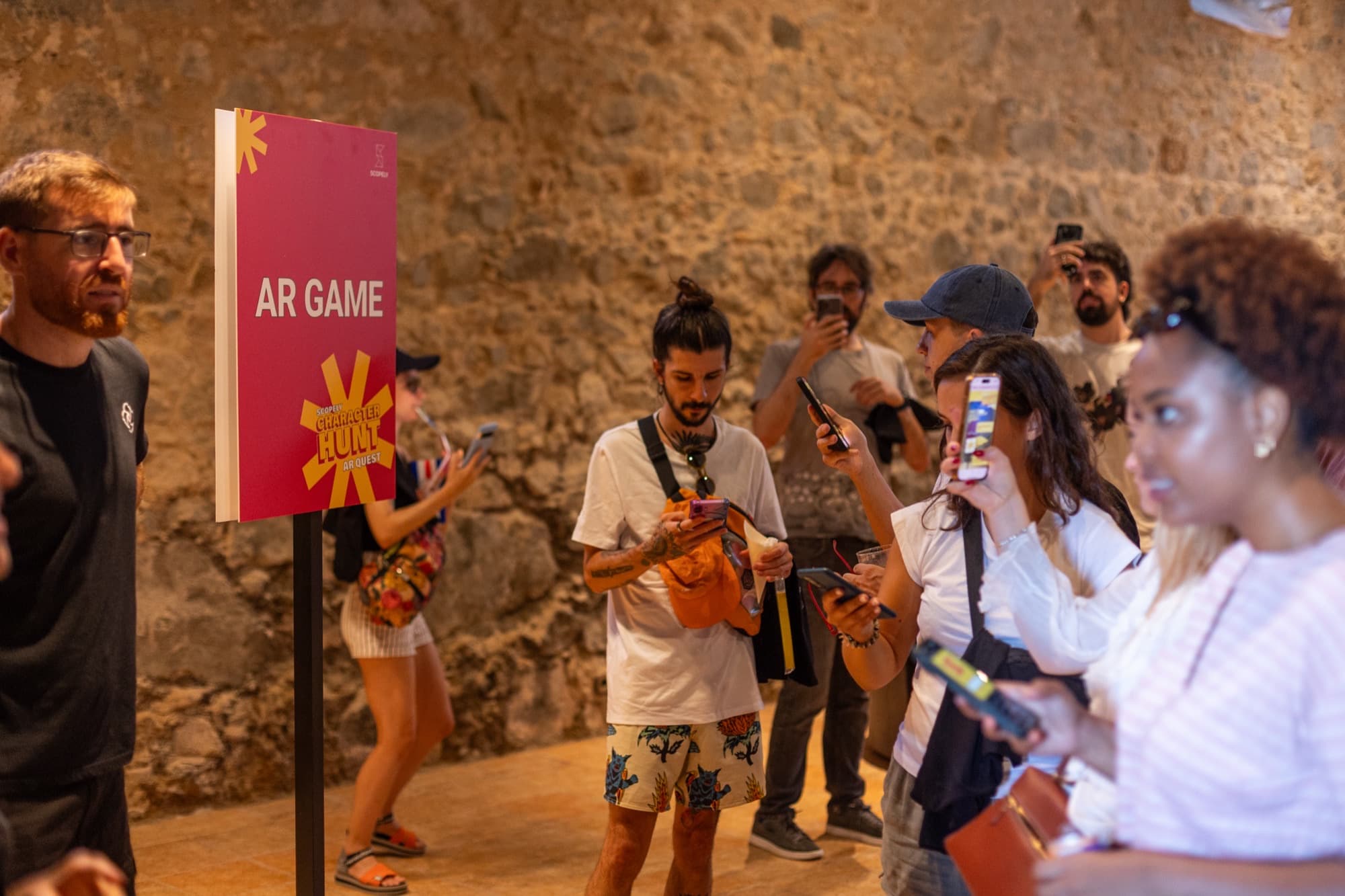
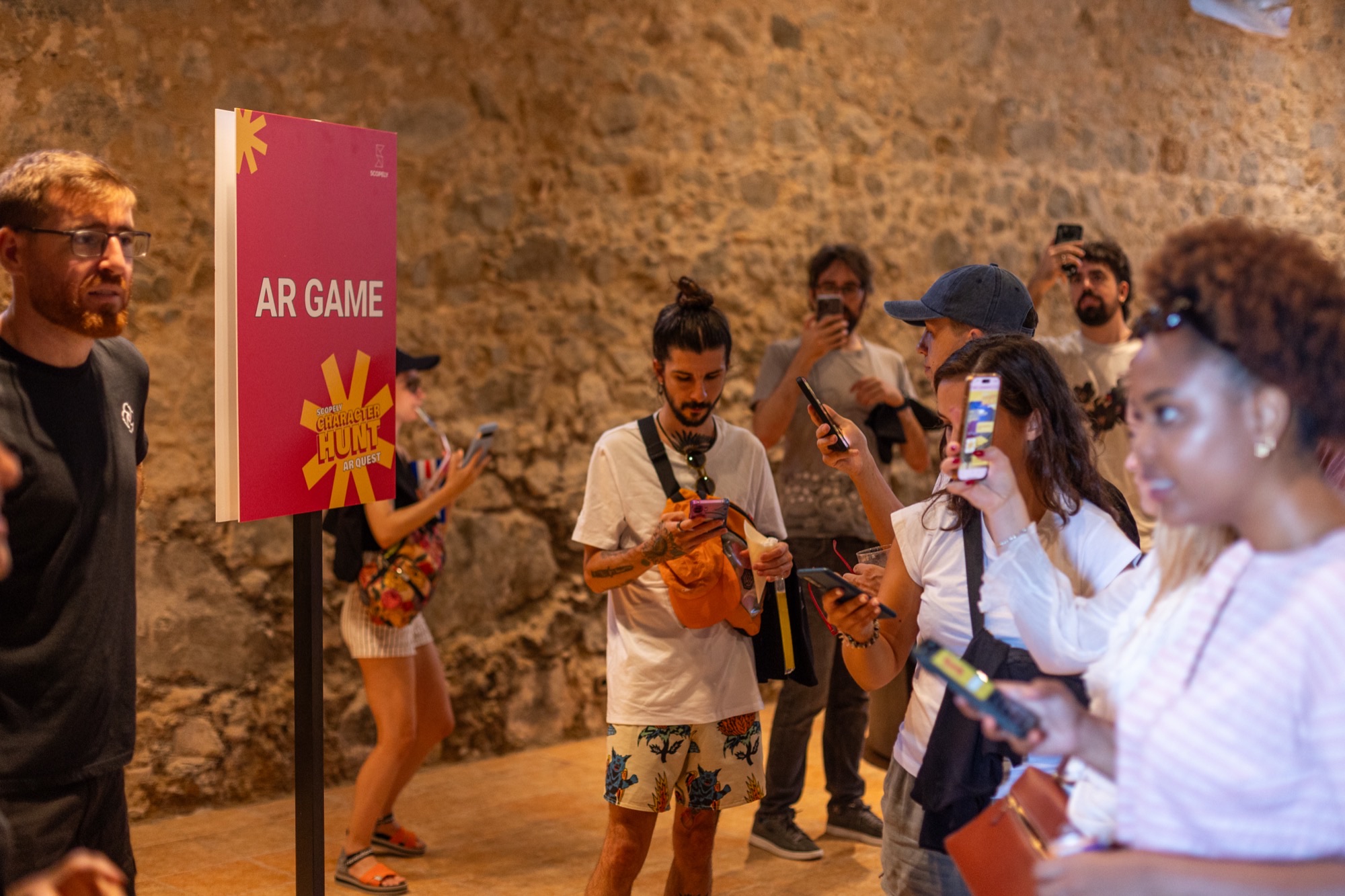
Scopely’s Global Celebration Day brought 2,400 employees together across 12 hubs, from Tokyo to Mexico, each running the event in its own time zone. Part of it was a character hunt in the browser: one QR code, no app, characters that appear as you walk and that you befriend with the right prop. I was the only engineer: the AR experience, the score API, the database and the staff dashboard.
At a glance
- 12 hubs, one day, served by a single deployment and the same QR code everywhere.
- Designed for approximately 2,100 players; Scopely’s global employee-experience lead reported 2,400 employees at the event.
- Five-week core build (7 July to 8 August 2025), then three weeks of refinement, including anti-cheat.
- Targets: iOS 14+ and Android 8+, 60 fps on mid-range phones.
An event space became a character hunt
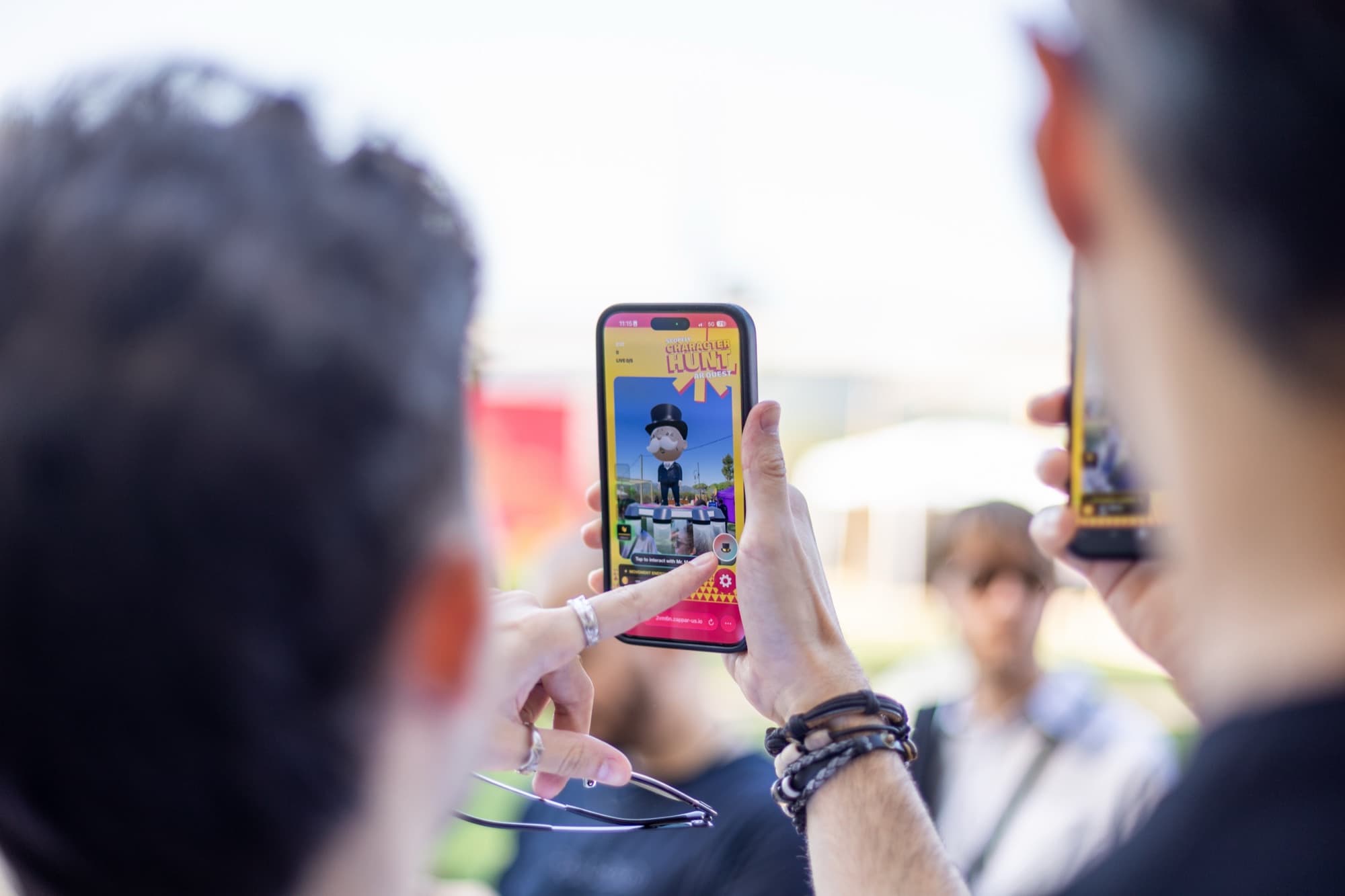
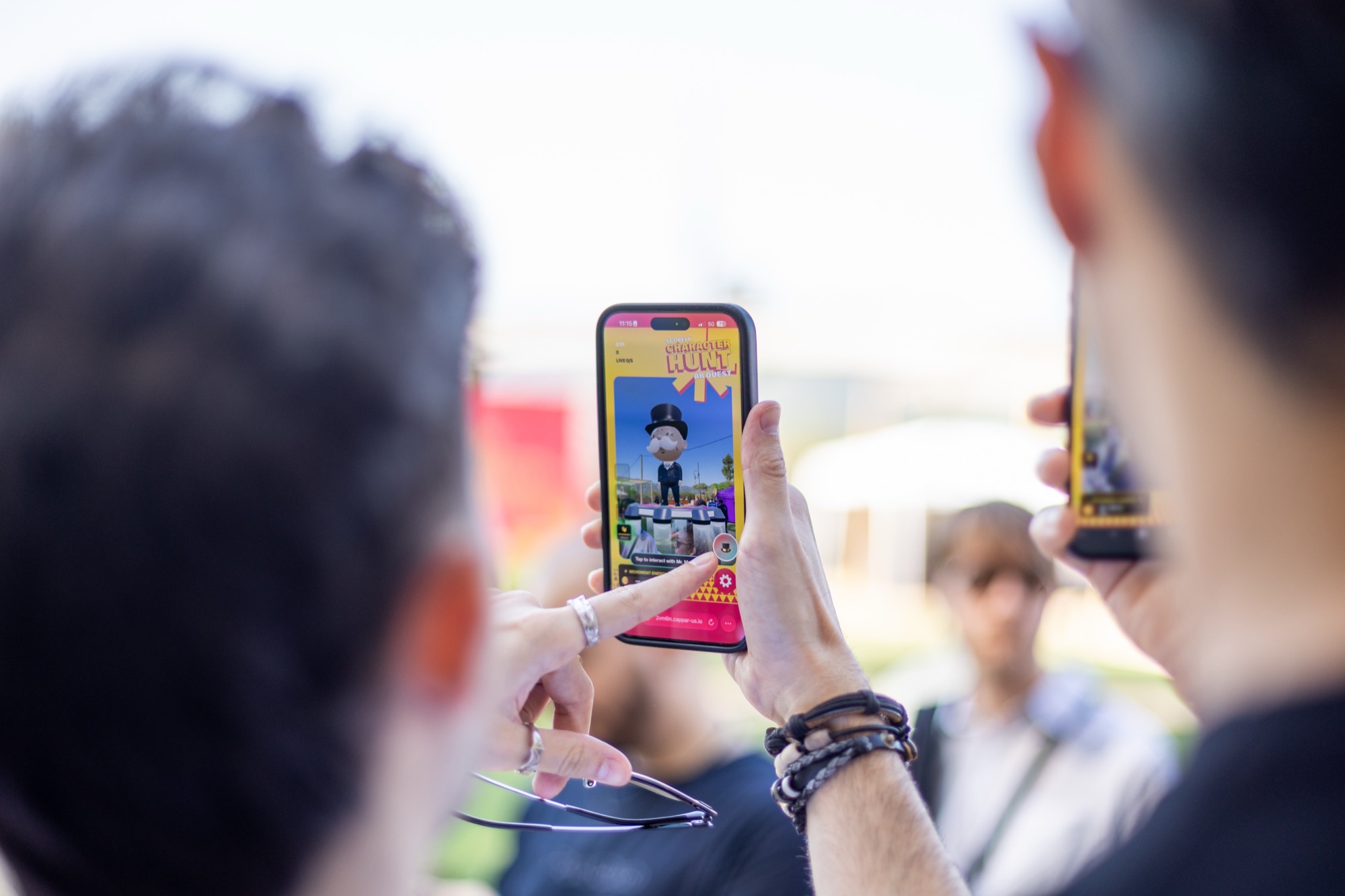
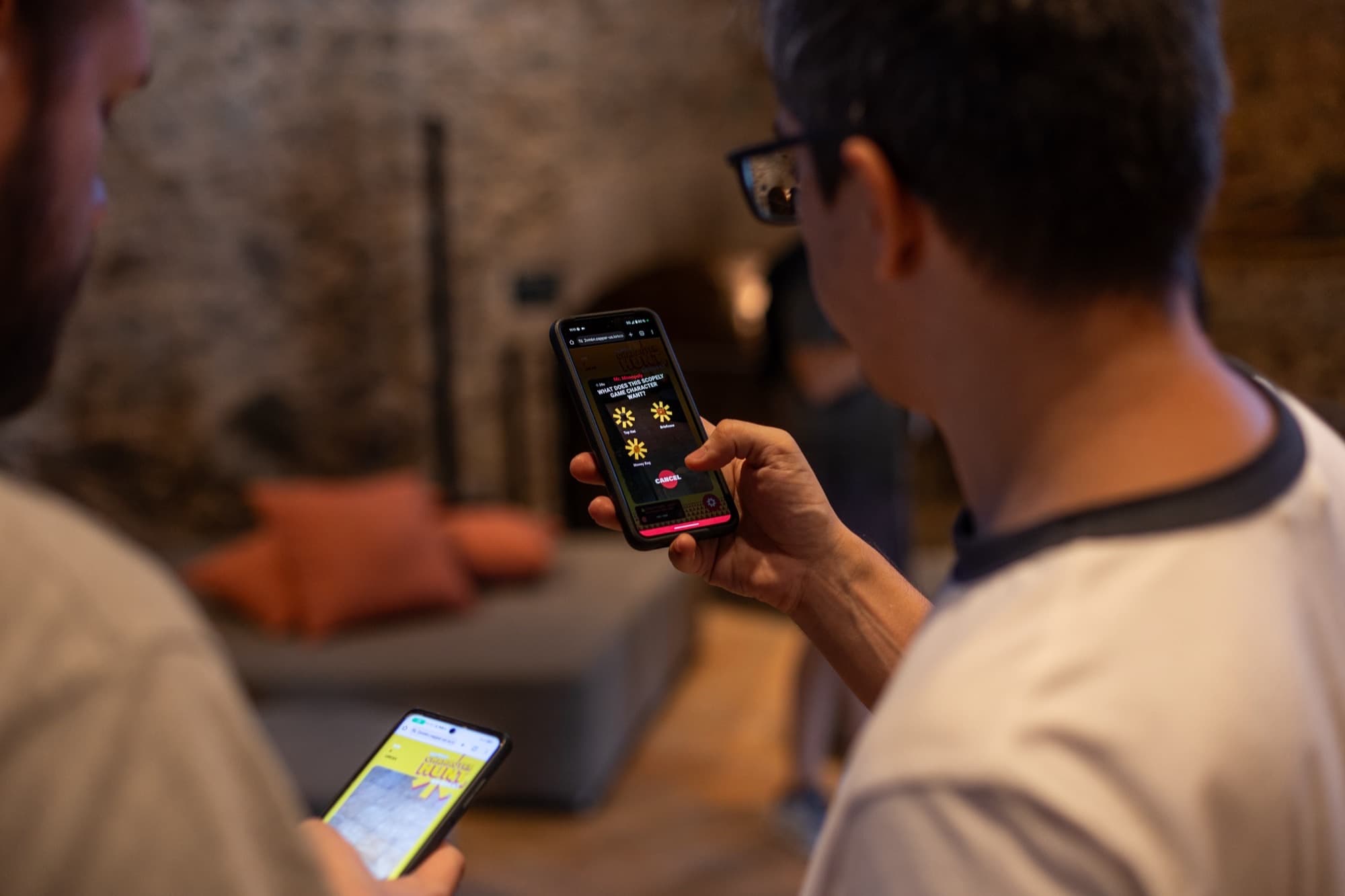
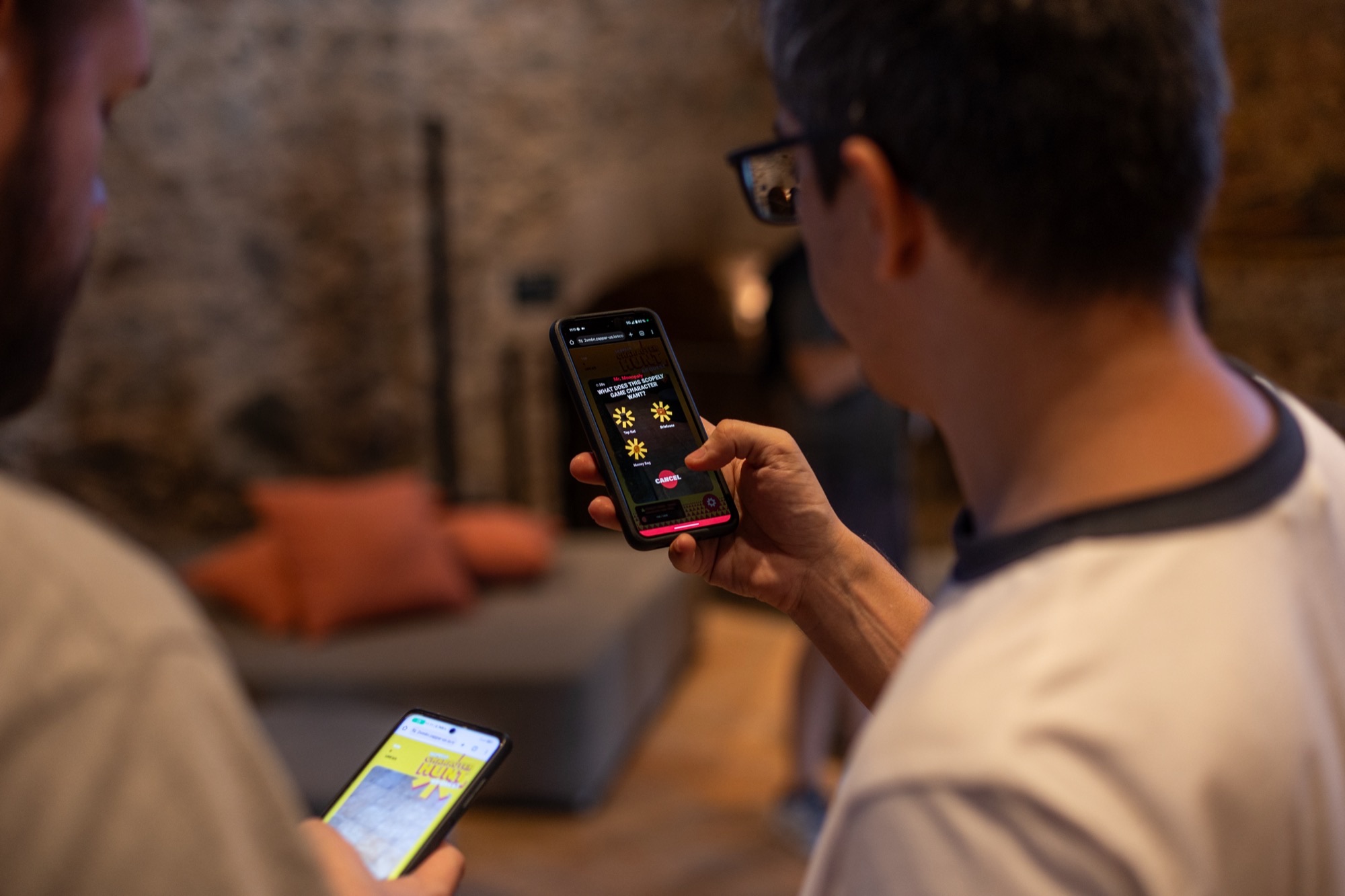
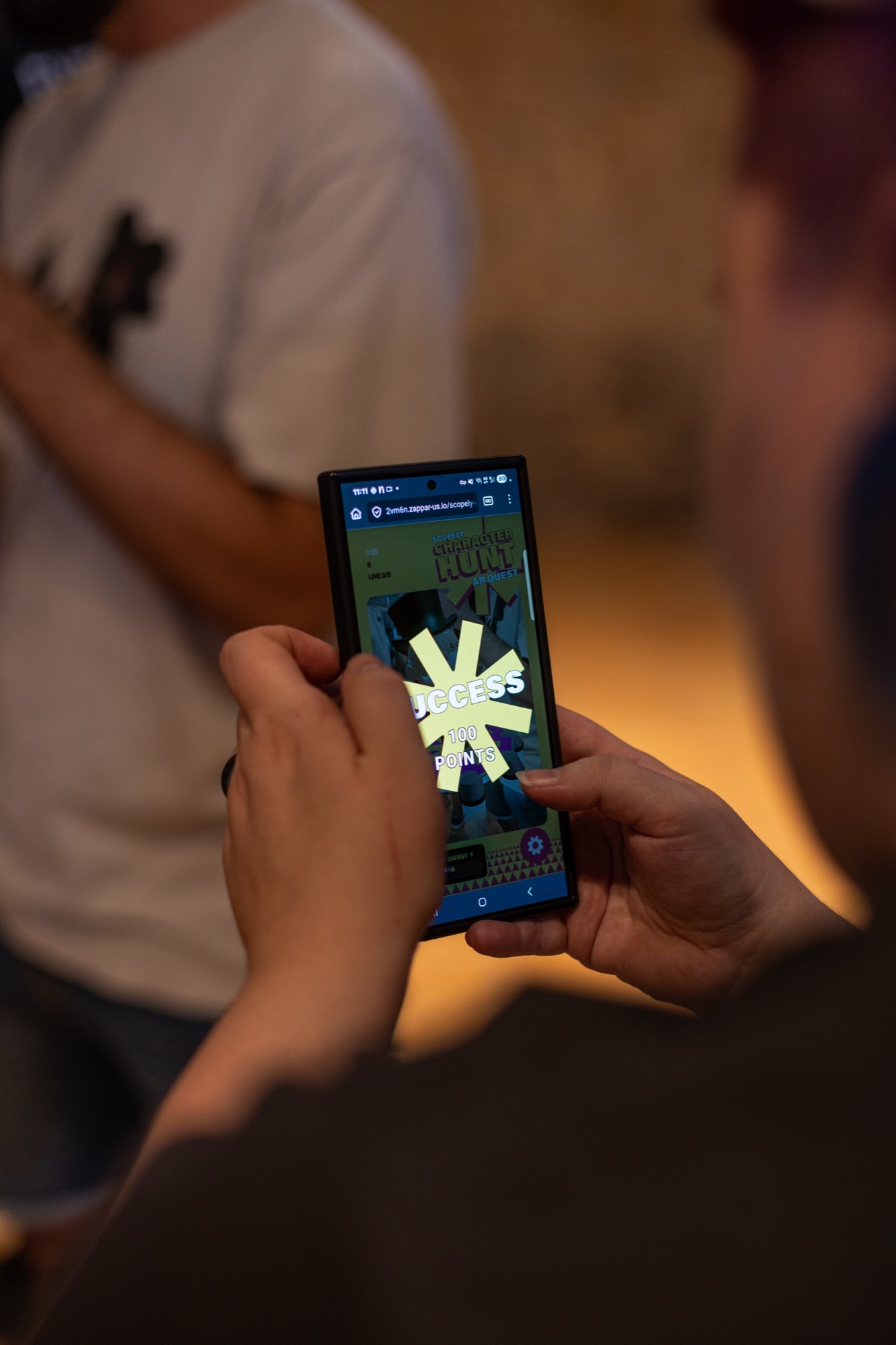
Participants used their phone’s browser to discover five characters around the venue and choose the right prop to befriend each one. Walking builds energy; standing still lets it decay. Each character appears at its own energy threshold, and new power moves (spin, jump, wave, a quick dodge) unlock as energy grows. Pick the wrong prop and the character leaves, then comes back for another try. Each encounter contributed to a final summary of points, characters found and completion time, without an app download.
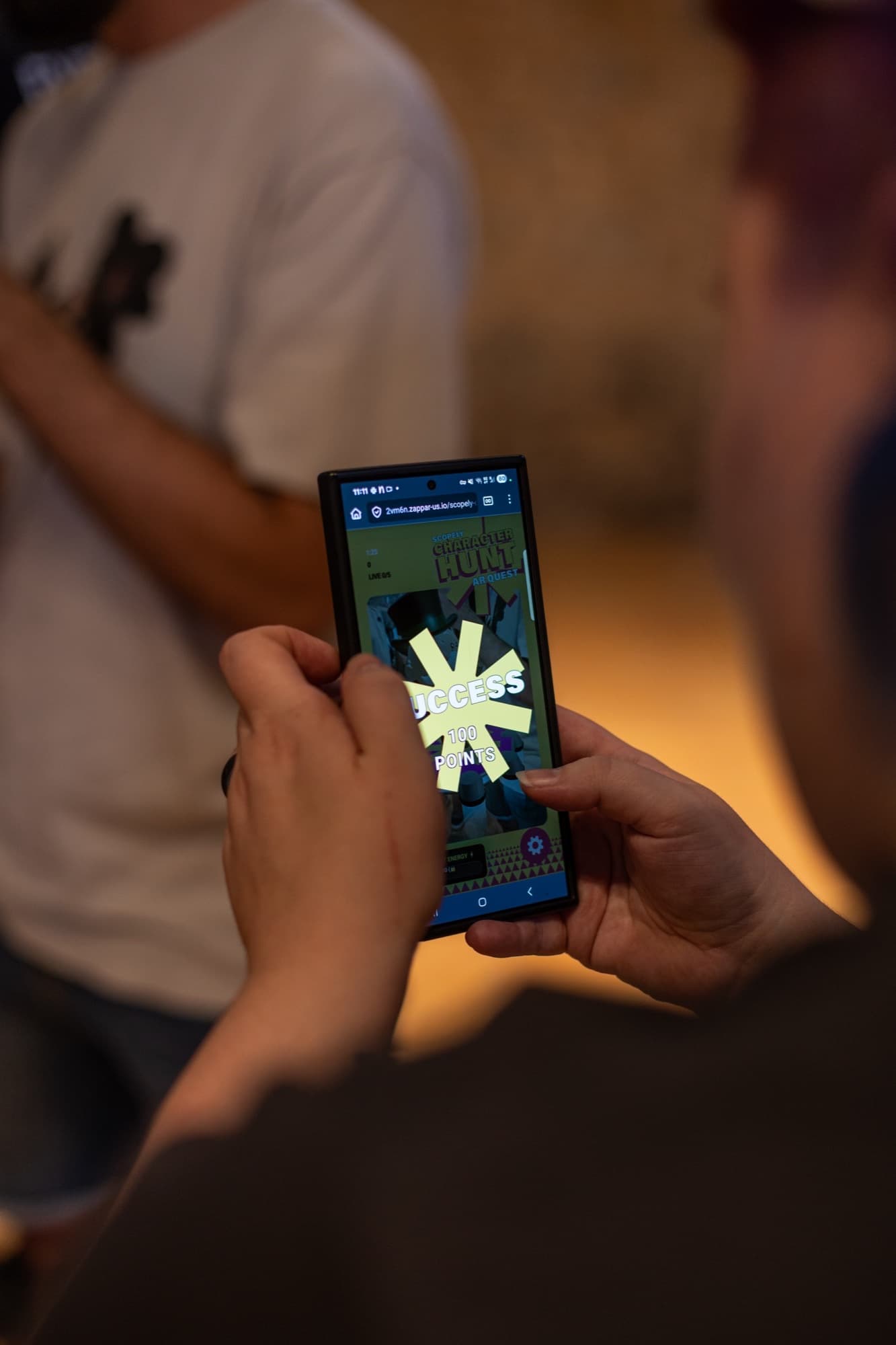
My responsibility
The scope planned a front-end developer and a back-end developer; I was both. I built the Mattercraft/Zappar browser experience and its gameplay, the Azure Functions API, the Cosmos DB data model and the React dashboard event staff used. Filipe Lopes Pires was the project manager, and John’C Salansky designed the moodboard and the UI and prepared the 3D characters.
TypeScript · Mattercraft / Zappar · Azure Functions · Cosmos DB · React
Why the browser
Walk-up players at a venue will not install an app for a one-off game, so the hunt ran in the phone’s browser from a single QR code. Mattercraft provided the AR scene; TypeScript ran the game and talked to the backend.
The cost is that the browser becomes the operating environment. Camera and motion permissions have to be requested at the right moment, sensors behave differently on every phone, and frame rate depends on hardware nobody controls. Everything below is about making one experience behave on all of them.
Handling permissions and movement on real phones
The interaction relies on device movement, so the code tracks sensor availability, motion permission, activity, and game state. Movement thresholds and callbacks connect sensor observations to gameplay rather than putting all behaviour in a single event handler.
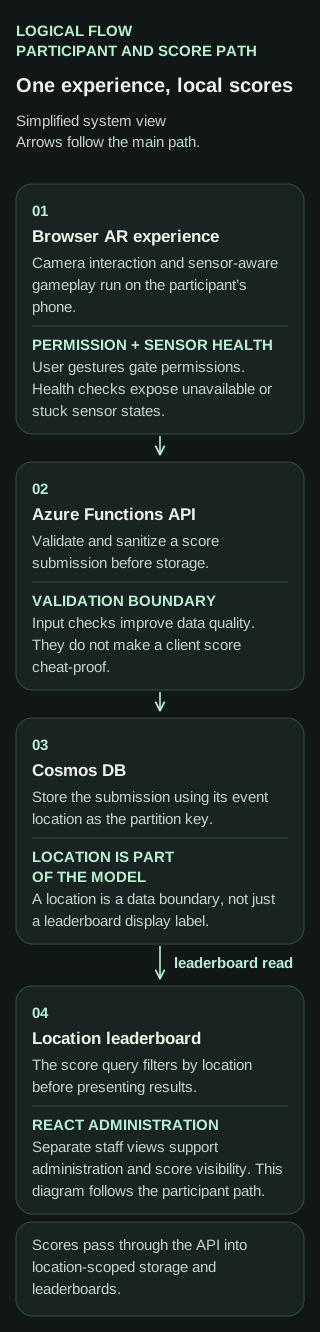
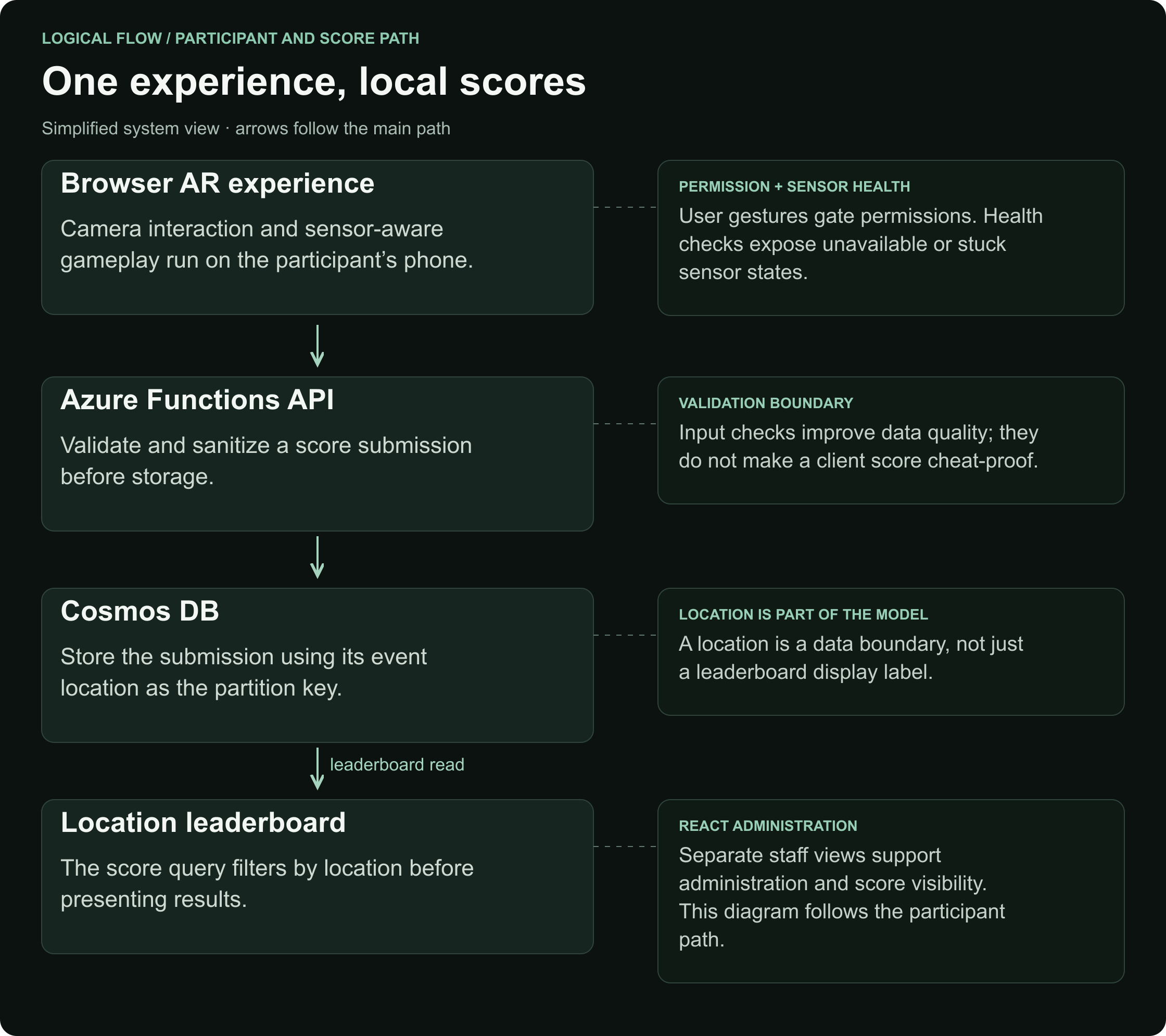
A concrete browser constraint appears in the permission flow: on iOS, requesting motion permission requires a user gesture. The sensor manager uses the permission obtained at the entry screen’s gesture gate, avoiding a second request from background setup that could produce a permission error.
That separation matters because “the sensor API exists” and “the browser is delivering usable events” are different states.
Detecting a silent sensor path
The sensor manager checks health every five seconds and tracks how long it has been since activity arrived. Ten seconds without activity is treated as a stuck-sensor condition, which can switch the sensor status into a fallback mode.
The scope asked for a timer that would spawn characters on phones without usable sensors. A timer like that walks for you, which would let anyone progress by standing still: the very cheat the game had to prevent. The fallback that shipped is narrower. Once a player reaches 80% of the energy needed for the next character, energy trickles in on its own, one point every two seconds, so a slow walker or a weak sensor still gets over the line to every character. Standing still never skips ahead, because the trickle only starts near a threshold.
Tradeoff: a phone that delivers no motion events at all cannot reach that first 80%. In exchange, movement stays meaningful for everyone else.
Walking, not shaking
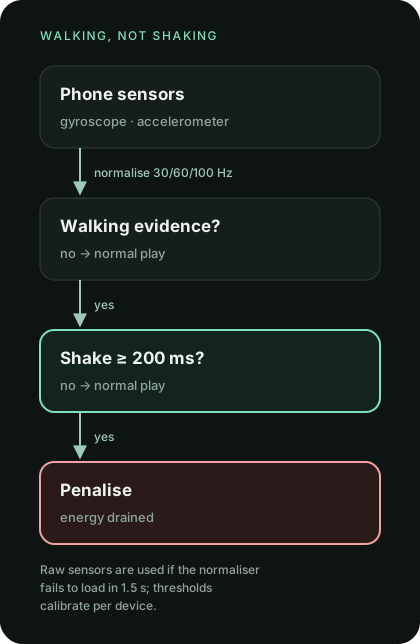
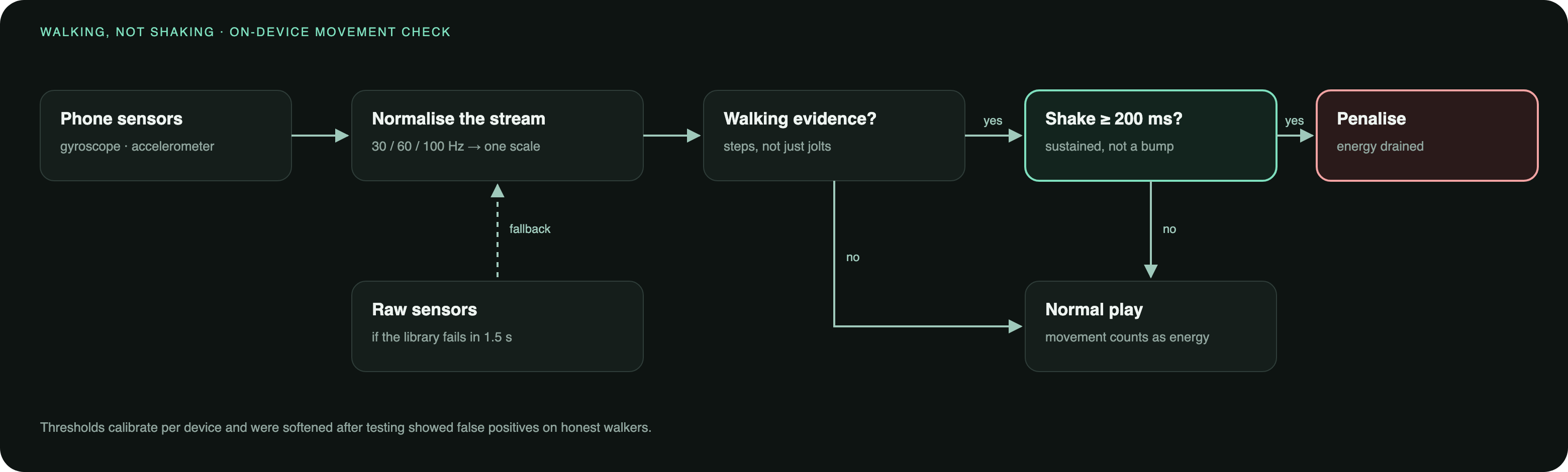
The game rewards movement, so the cheapest cheat is to stand still and shake the phone. Telling the two apart on a phone is harder than it sounds. iOS and Android sample motion at different rates (30, 60 or 100 Hz), so I normalised the sensor stream first, falling back to the raw sensors if the normalising library did not load within 1.5 seconds. Shaking is only penalised when there is also evidence of walking and it lasts at least 200 ms, so a real walker who jolts their phone is not punished. Thresholds calibrate to each device, and I softened them after testing showed too many false positives.
Tradeoff: every extra bit of strictness catches more cheats and more honest players. I tuned towards fairness, because the game was never meant to be a competition.
The plan was as explicit about what not to build: no machine learning, no GPS indoors, motion sensors only, and no harsh penalties beyond the one targeted case of an obvious heavy shake.
A small backend, made defensible
Every score carries its location, and Cosmos DB is partitioned by it. That follows how the event was run: staff and players care about the results at their own venue, so a local leaderboard is a single-partition read rather than a global query filtered in the interface. Global reporting, in return, needs explicit aggregation.
The scope called for a minimal backend: per-location endpoints and admin pages protected only by obscured URLs. I kept it small but made it defensible. The server clamps every score to the 2,000-point maximum, accepts only the 12 known location codes, filters nicknames and rejects timestamps from the future. Each IP can submit five scores per location per hour, counted inside that location’s partition, and score data, including the IP used for rate limiting, deletes itself after seven days. A React dashboard gave each hub’s staff their own results.
The honest gaps: the endpoints are anonymous, a retried request can store a duplicate score, and an IP limit can catch real players sharing venue Wi-Fi. Server checks make browser-submitted data usable; they do not make a browser game cheat-proof.
Testing on real phones
Testing was manual and on real devices: about 70 single-purpose test pages for sensors, permissions, spawning and scoring, plus an event-day FAQ I wrote once and the organisers distributed to all 12 hubs, so local staff could handle camera, motion and character problems without an engineer at each hub. There were no automated tests; with hindsight, that is the first thing I would add.
Result
The hunt ran at all 12 hubs on the same day, designed for approximately 2,100 players, as part of a celebration Scopely reported at 2,400 employees. The core implementation took five weeks, followed by three weeks of refinement.
The participant experience, data model and staff workflow were developed as one connected product.
Event photography
What I would improve next
Automated tests first: the energy and anti-cheat rules live in their own managers and could be tested against recorded sensor traces, and manual device passes do not scale past one event. Then a retry contract for score submission, with an idempotency key so a retry can never create a duplicate. And per-location request and error metrics, so on the day the team could tell device friction from backend problems at a glance.